
Quantitative Premise and Testing Rationale
Large datasets from comparative durability studies indicate that properly designed accelerated exposures produce repeatable ranking of materials, permitting quantitative lifetime estimation; this analysis begins by treating exposure profiles as experimental variables rather than fixed settings, and it assumes primary use of a weathering chamber to reproduce ultraviolet, moisture, and thermal cycles. Data-centric evaluation demands explicit metrics—irradiance, spectral fidelity, temperature control, cycle timing and cumulative radiant dose—so that measured degradation can be translated into field-relevant outcomes with known uncertainty.
Core Metrics and Measurement Protocols
Establish measurable targets before equipment selection. Spectral match to terrestrial sunlight and the choice of wavelength bands (for example, those specified by ASTM G154 or similar standards) determine the chemical pathways accelerated by the test. Control of black-panel temperature and relative humidity reduces confounding thermal and hydrolytic effects. Dose-based metrics—total radiant exposure and dose rate—should accompany time-based schedules; reporting both improves inter-laboratory comparability and permits regression to outdoor failure rates when supplemented by field correlation data.
Comparative Assessment of Equipment Types
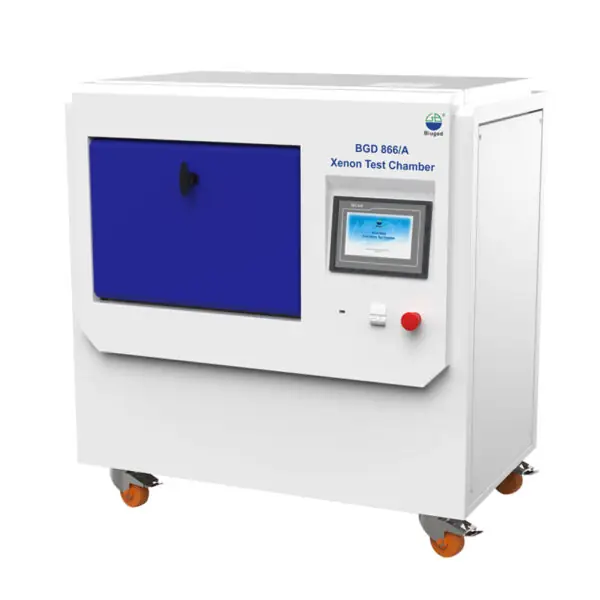
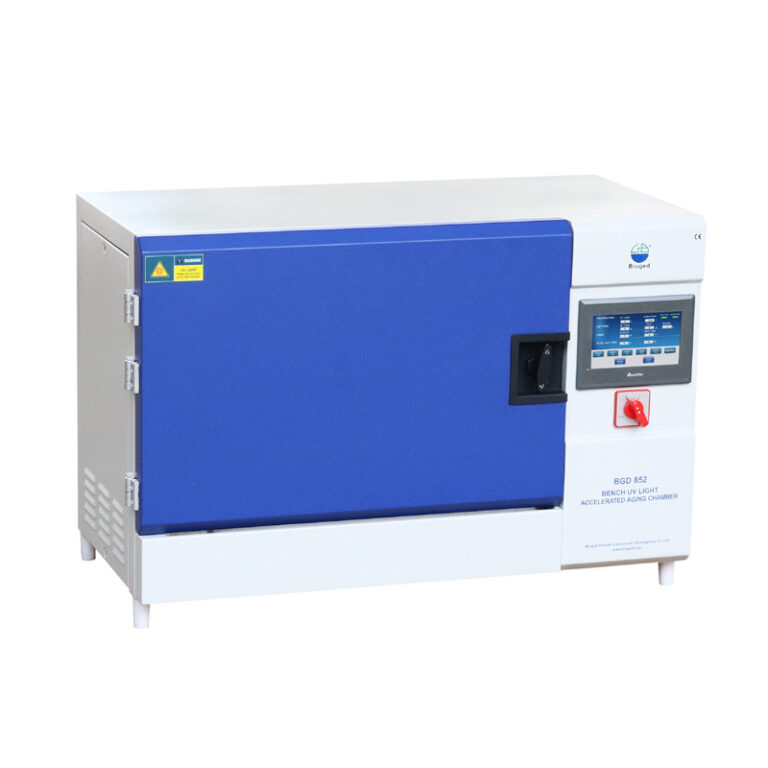
Fluorescent UV devices deliver stable irradiance at discrete UVA bands and excel for polymer surface degradation studies; xenon-arc systems offer full-spectrum simulation including visible and infrared components and better predict color and gloss changes for coatings; combined condensation or water spray options simulate moisture-assisted mechanisms. Choose by aligning device strengths with the dominant degradation modes of the material: photolytic surface embrittlement favors fluorescent lamps, while optical fading and multi-mechanism ageing favor xenon. Consider throughput, chamber uniformity, lamp aging characteristics and calibration procedures when comparing models.
Common Pitfalls and Experimental Errors
Three recurring errors undermine validity: assuming linearity between accelerated dose and real-time exposure without cross-validation; neglecting spectral mismatch that shifts reaction pathways; and failing to control or report temperature gradients across specimens. Mounting configuration, specimen thickness, and edge effects alter local dose absorption and must be standardized. Do not extrapolate from a single short-duration test to long-term performance without multi-factor validation; instead, combine accelerated runs with targeted outdoor exposures for calibration.
Experience, Authority, and a Real-World Anchor
Practitioner experience matters: laboratories with sustained polymer-testing programs develop reference libraries that reduce interpretation variance and identify assay drift. A practical anchor for such laboratories appears in Guangdong province, where multiple ISO/IEC 17025–accredited facilities routinely compare accelerated protocols against field returns; those comparisons reveal systematic offsets attributable to spectral content rather than simple dose rate differences. For procurement or technical comparison purposes consult device descriptions and calibration histories for the specific accelerated weathering tester models under consideration, and prioritize suppliers who provide spectral output data, calibration schedules and inter-instrument validation records.
Implementation Guidance and Decision Criteria
Define failure modes quantitatively (e.g., 50% tensile loss, 10% optical density change) before selecting equipment. Specify required sample throughput and chamber footprint to match production-test cycles. Require vendors to supply spectral irradiance curves, chamber uniformity maps, and recommended maintenance intervals. Validate chosen protocols by running a small factorial study that varies irradiance and cycle parameters; use statistical analysis to identify non-linear responses and to establish confidence intervals on projected field lifetimes.
Concluding Synthesis
Data must drive every selection and procedure: specify metrics, demand calibration evidence, and validate accelerated results against field-derived benchmarks to reduce uncertainty. A supplier that supplies instrument-level spectral data, calibration services and documented laboratory comparatives integrates into that workflow; such completeness is the practical value offered by BIUGED when laboratory planners require traceable, comparable accelerated exposures rather than opaque test numbers.